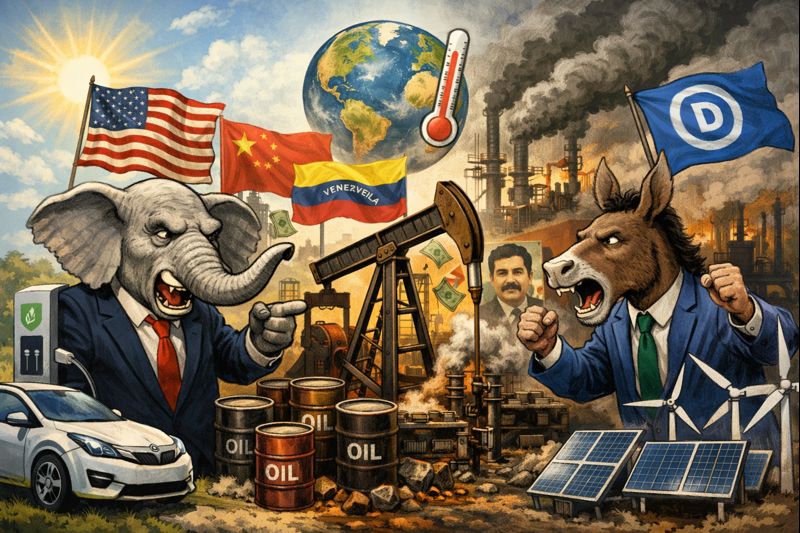
At some point, you start to wonder if the Republican–Democrat rivalry is less a governing philosophy and more a long-running improv bit. Same stage, same props, same punchlines. The latest episode stars Venezuela’s oil, China’s electric vehicles, and a bipartisan refusal to admit that everyone might be complicit.
On one side of the political aisle, there’s renewed enthusiasm for “doing something” about Venezuela. That “something” includes openly floating the idea of taking control of the country’s state oil company, PDVSA, in the name of lower oil prices and American energy dominance. The logic is familiar. If oil prices are high, America must intervene. If oil prices fall, America deserves credit. If things go sideways, blame the other party and move on.
On the other side, Democrats offer a familiar response as well. Lots of concern about legality, international norms, and decorum. Fewer objections to the underlying premise that U.S. prosperity remains tightly tethered to who controls foreign oil fields. The outrage tends to focus on process, not outcome. It’s less “Why are we still doing this?” and more “Did you file the correct paperwork before doing it?”
Meanwhile, reality keeps intruding. China, long one of Venezuela’s biggest oil customers, is slowly but decisively reshaping its energy consumption. Electric vehicles are no longer niche novelties there. They’re mainstream, and they are beginning to dent oil demand in ways that no amount of political spin can fully ignore. China still imports massive amounts of oil, but the trajectory is clear. The future involves fewer barrels, not more.
That makes the American obsession with controlling Venezuelan crude feel less like strategy and more like nostalgia. It’s the geopolitical equivalent of buying Blockbuster stock because you once had a great Friday night there in 1997. Even if the United States manages to muscle Venezuelan oil onto global markets, the payoff may be smaller and shorter-lived than promised. Markets already know this, which is why oil prices tend to shrug rather than salute whenever politicians announce bold energy maneuvers.
The funniest part, if it weren’t so exhausting, is how both parties frame this as a moral struggle. Republicans cast it as strength versus weakness. Democrats frame it as norms versus recklessness. Neither wants to dwell on the uncomfortable fact that both sides are still organizing the future around fossil fuels while publicly claiming to be preparing for a post-fossil-fuel world.
Climate change hovers over all of this like an uninvited guest everyone pretends not to see. Democrats talk about clean energy while tolerating fossil-fuel power plays abroad. Republicans mock climate policy while quietly benefiting from market forces that are pushing renewables and electrification forward anyway. The transition isn’t happening because Washington planned it well. It’s happening despite Washington’s inability to stop arguing long enough to notice.
Venezuela’s oil, China’s EV boom, and America’s endless partisan shouting all point to the same reality. The world is changing faster than our political narratives. Oil still matters, but it no longer owns the future the way it once did. Acting like it does may win a news cycle, but it won’t change where markets, technology, or physics are headed.
At some point, the question stops being which party is winning the argument and starts being whether anyone is actually solving the problem. Right now, the answer looks uncomfortably bipartisan.



 The Political Middle Child
Leave a comment