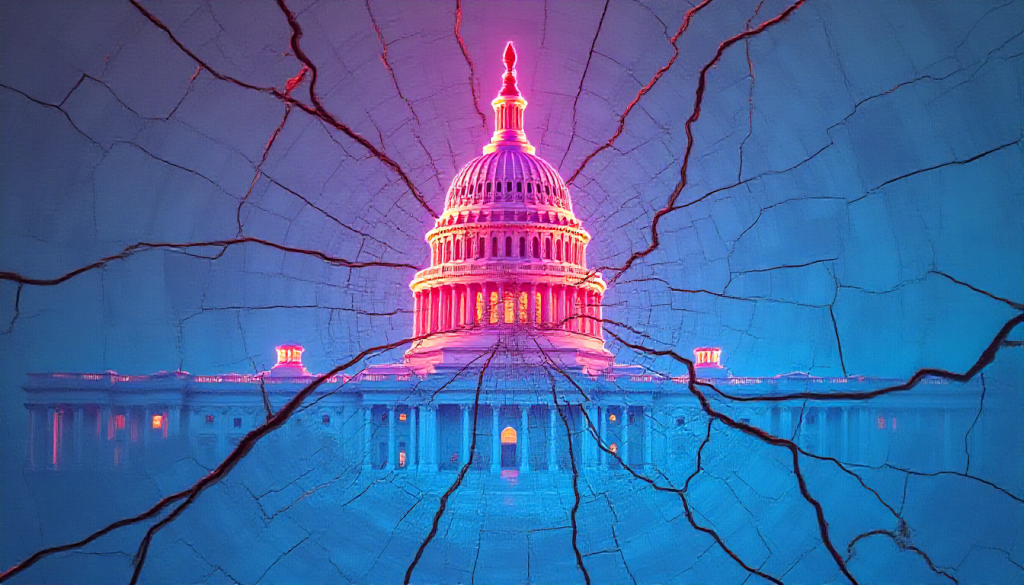
If you want to understand American foreign policy in 2026, don’t bother with white papers or congressional hearings. Just picture two grown adults screaming “YOUR FAULT” across a burning room while insisting they’re the only one holding a fire extinguisher. Welcome to the bipartisan response to Venezuela, Russia, and yet another episode of Washington pretending chaos is strategy.
The latest flare-up centers on Venezuela, where the U.S. dramatically escalated its involvement by capturing Nicolás Maduro on drug trafficking charges, triggering deadly clashes, international condemnation, and a fresh round of global side-eye. Roughly a hundred people died in the process. The United Nations was unhappy. Several foreign political groups were furious. Washington, however, was thrilled to finally have something new to argue about.
Republicans wasted no time framing the operation as a bold strike against tyranny, corruption, and, conveniently, Russia. Conservative commentary cast it as a masterstroke, weakening Moscow’s global influence while dismantling a narco-state that’s been a thorn in America’s side for years. The implication was clear: this wasn’t intervention, this was liberation, with a side of national pride and a dash of chest-thumping nostalgia for the days when American power didn’t bother with disclaimers.
What rarely made it into the victory speeches was the lack of a coherent plan for what comes next. Capturing a dictator is one thing. Governing the aftermath is another. When President Trump suggested the United States might temporarily “run” Venezuela until stability returns, the line between enforcement and occupation got blurry fast. That’s not liberation. That’s a hostile takeover with better branding. And yes, it’s impossible to ignore that Venezuela happens to sit on one of the largest oil reserves on the planet. Funny how that keeps happening.
Democrats, for their part, reacted exactly as expected: with grave concern, stern warnings about international law, and an impressive ability to sound outraged while offering no alternative path forward. They criticized the operation as unconstitutional, unilateral, and destabilizing, which is all technically accurate. It’s just hard to hear lectures about sovereignty from the same party that supported interventions in Iraq, Libya, and Afghanistan when it suited the moment. International law, in Washington, tends to function less like a rulebook and more like a buffet.
Democratic leaders emphasized that this is precisely why foreign policy shouldn’t be conducted without Congress, while quietly avoiding the fact that Congress has been functionally allergic to responsibility for years. They also pointed out that Russia is now watching closely, reassessing its ability to project power abroad. That part is true, but not for the reasons either party seems eager to admit.
Russia’s involvement in Venezuela was never the linchpin of its global strategy. Moscow’s real focus has been Ukraine, Europe, and shoring up influence closer to home. Venezuela was an investment, not a lifeline. So when conservative voices declare this a blow to the “heart of Russia,” they’re overselling the damage. And when liberals warn this action risks provoking authoritarian powers worldwide, they’re overstating how central Venezuela ever was to Moscow’s ambitions.
In reality, what this episode reveals isn’t American dominance or Russian collapse. It reveals how often U.S. foreign policy is driven by domestic politics rather than long-term planning. Republicans needed a show of strength. Democrats needed a reason to call it reckless. Neither side seems particularly interested in the Venezuelan people beyond how well they fit into the narrative.
Meanwhile, the practical questions remain unanswered. Who governs Venezuela now? How is stability enforced without prolonged occupation? Who controls the oil revenue, and how transparently? What happens when regional backlash turns into something more than angry statements? These aren’t partisan questions. They’re the basics. And they’re being drowned out by soundbites.
From the outside, the spectacle looks less like leadership and more like a dysfunctional couple arguing in public while insisting the neighbors mind their business. Protests have already rippled beyond Latin America. International trust continues to erode. And every new crisis reinforces the impression that Washington’s first instinct is action, its second instinct is spin, and its last instinct is accountability.
The uncomfortable truth is that both parties are right about what the other gets wrong, and both are blind to their own reflection in the mess. Republicans talk about freedom while flirting with empire. Democrats talk about norms while selectively enforcing them. And neither side wants to admit that decades of bipartisan decisions laid the groundwork for exactly this kind of instability.
So here we are again. Another foreign crisis. Another round of moral outrage. Another opportunity missed to do something boring, deliberate, and effective instead of loud and theatrical. The world watches. Venezuela bleeds. Russia recalculates. And Washington congratulates itself for winning an argument no one else wanted to have.
At least there’s one thing Democrats and Republicans can still agree on: whatever’s happening right now would be going much better if the other party weren’t involved.
And that, apparently, is still the closest thing we have to a foreign policy doctrine.

 The Political Middle Child
Leave a comment