Welcome to the latest installment of American policy theatre, where tradition meets tumult and the national dietary guideline becomes the newest battleground for ideological sparring, complete with enough contradictions to fill a salad bowl.
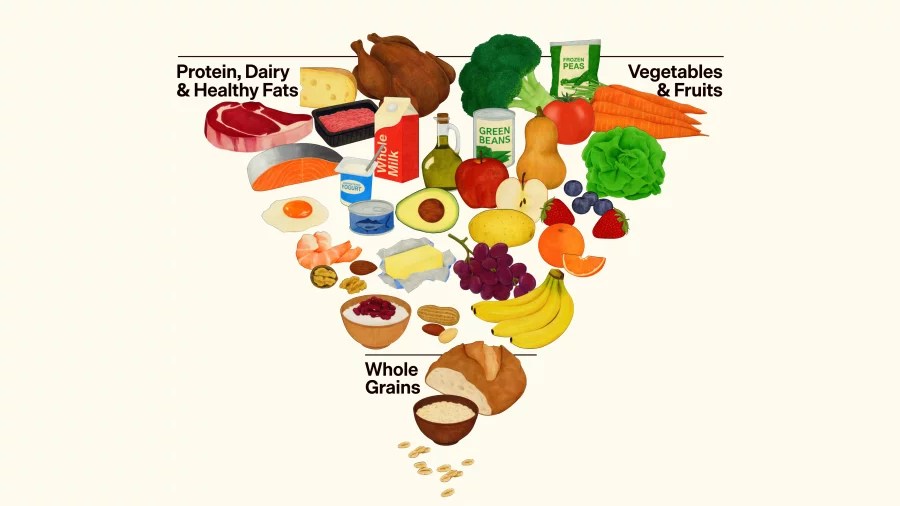
On January 7, 2026, the Trump administration, with Health and Human Services Secretary Robert F. Kennedy Jr. at the forefront, unveiled the Dietary Guidelines for Americans, 2025 to 2030. Marketed as the most consequential overhaul of federal nutrition policy in decades, the new guidelines take aim at ultra-processed food, champion “real” food, elevate protein, and upend decades of nutritional orthodoxy. Beans still matter. Vegetables still matter. But red meat, full-fat dairy, butter, and animal fats are no longer treated like guilty pleasures hiding at the edge of the plate.
At first glance, the shift has broad appeal. After years of Americans constructing meals out of ingredients that sound more like chemistry experiments than food, the call to reduce sugar and highly processed products feels overdue. Even critics concede that emphasizing whole foods over industrial formulations is a legitimate public health goal.
The confusion begins when the science and the symbolism start to drift apart.
For decades, federal dietary guidance leaned on a relatively cautious scientific consensus. Eat fruits and vegetables, prioritize whole grains, choose lean proteins, and limit saturated fats to reduce cardiovascular risk. That framework did not appear by accident. It was built on long-running evidence reviews and population-level health data. The new guidelines technically retain limits on saturated fat, yet visually elevate red meat, full-fat dairy, and animal fats within their core messaging. The result is a mixed signal. Are Americans being encouraged to eat healthier proteins, or simply given permission to reinterpret indulgence as wellness?
Critics also note that the advisory process itself was not free from controversy. Some contributors to the scientific review process reportedly had financial ties to the beef and dairy industries, which raised concerns about whether ideology and economics crept into a document billed as a return to evidence-based integrity. That irony was not lost on public health experts who have spent years warning about industry influence in nutrition science.
Then there is alcohol, a topic where clarity quietly evaporated. Earlier drafts of the guidelines included more specific limits on alcohol consumption, aligning with growing research linking even moderate drinking to increased cancer risk. In the final version, those limits were softened into general advice to drink less. Public health advocates noticed. So did the alcohol industry. The outcome felt less like scientific refinement and more like a political compromise.
Supporters of the new approach argue that the focus on real food and reduced processing is long overdue. Organizations focused on chronic disease prevention acknowledge that ultra-processed diets have contributed to rising rates of obesity, diabetes, and cardiovascular disease, all of which place enormous strain on the healthcare system. On that front, the guidelines reflect a genuine shift toward addressing root causes.
Opponents counter that loosening the rhetoric around saturated fat and red meat risks undoing decades of progress in heart health education. They argue that nuance gets lost when federal advice becomes cultural messaging, especially when the public reads visuals more closely than footnotes.
The stakes extend well beyond individual dinner plates. Federal dietary guidelines influence school lunches, military meals, SNAP benefits, and public health campaigns nationwide. A shift in guidance does not stay confined to policy documents. It becomes operational reality for millions of Americans.
Which brings us to the uncomfortable truth behind the food fight. Nutrition policy in Washington has never been just about nutrition. It is about culture, economics, lobbying, and politics, often in equal measure. One administration’s war on processed food becomes another administration’s redemption arc for butter and beef, and the public is left sorting through the contradictions.
Eat real food is good advice. Pretending that decades of complex nutritional science can be neatly inverted into a new pyramid is less convincing. The science is evolving, but it is not swinging on a political pendulum as fast as the messaging suggests.
So while Americans debate what belongs at the base of their plates, one lesson remains constant. Federal dietary guidance may change every five years, but the partisan tug-of-war shaping it never really stops. And if the goal is public health clarity, the noise surrounding these guidelines may still be the least healthy ingredient of all.


 The Political Middle Child
Leave a comment