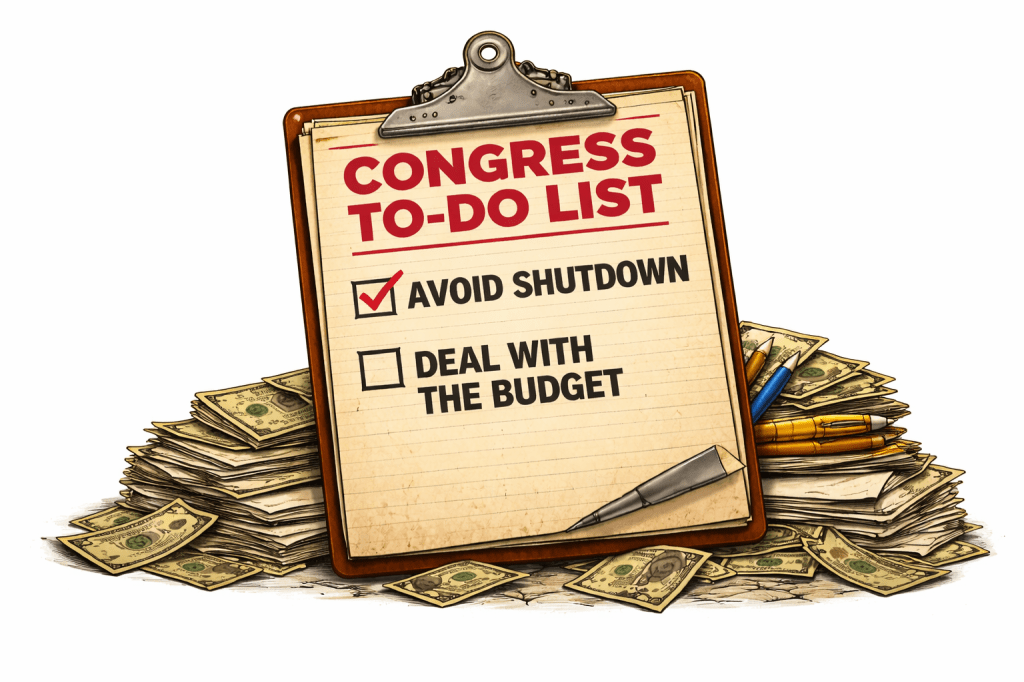
Congress has once again discovered its favorite governing strategy: sprinting away from a crisis it created, then high-fiving itself at the finish line for not tripping over the Constitution on live television.
This week, the House passed a roughly $180 billion funding package to keep parts of the federal government running and avoid a shutdown that everyone swore would be catastrophic five minutes before voting to prevent it. Depending on which outlet you read, this was either a triumph of responsible governance or a near miss that proves Washington is infested with fraud-loving lunatics. As usual, the truth lives somewhere in the uncomfortable middle, right next to the American taxpayer.
From the more neutral telling, the bill was about keeping the lights on. A bipartisan majority moved to fund several government agencies through the end of the fiscal year, narrowly sidestepping another shutdown cliff. The package itself funds a broad slice of everyday government that rarely makes headlines unless it stops working. It keeps money flowing to agriculture and food safety programs, transportation and infrastructure projects, housing and urban development, veterans services, energy and water management, and a range of federal agencies that quietly handle everything from disaster response to nutritional assistance. In other words, it pays for the unglamorous but essential machinery of government, the stuff Americans only notice when it breaks. It does not address long-term spending reforms, entitlement growth, or structural budget imbalances. It simply keeps the doors open and the invoices paid until the next deadline arrives. Lawmakers congratulated themselves for acting like adults just long enough to pass a bill that, notably, does not solve the larger budget fight. It simply delays it. Again.
From the conservative angle, the story was less “responsible compromise” and more “hostage negotiation.” A faction of Republicans revolted over fears of massive fraud tied to Minnesota programs, arguing that rushing funding without stricter safeguards was irresponsible at best and reckless at worst. Leadership eventually pushed the package through anyway, prompting accusations that fiscal restraint is always promised and rarely delivered, especially when deadlines start breathing down Congress’s neck.
Both versions are true. That is the part no one likes to admit.
Yes, fraud concerns matter. Billions of dollars have been mismanaged in state and federal programs over the years, and waving that away as paranoia is how trust erodes. At the same time, governing by constant rebellion is not a plan. If every funding bill turns into a purity test, the government becomes less a functioning institution and more a reality show where everyone is auditioning for a future podcast.
Democrats, for their part, are doing their own version of the victory lap. They emphasize that the bill avoids a shutdown and protects key programs, framing Republican infighting as proof that the GOP cannot govern itself, let alone the country. That talking point lands, mostly because it keeps working. But it also conveniently ignores the fact that Democrats have grown very comfortable with last-minute funding deals that preserve dysfunction while claiming moral superiority for preventing catastrophe.
This is the bipartisan pattern. Republicans warn about spending, fraud, and accountability, then vote for massive packages once the clock hits 11:59. Democrats warn about shutdowns, chaos, and cruelty, then accept temporary fixes that guarantee the same fight will happen again in a few weeks. Both sides get to fundraise off the chaos. Neither side fixes the system that creates it.
The result is a government that technically functions but emotionally exhausts the people paying for it. Federal workers live in perpetual uncertainty. Businesses brace for disruption. Voters watch Congress lurch from deadline to deadline and are told, once again, that this was the best anyone could do.
Maybe that is the most honest part of the story. This was not a bold act of leadership. It was a routine act of survival. Congress did not solve a problem. It postponed one, loudly, and then blamed the other team for why it still exists.
The shutdown was avoided, and that is good. The bar, however, remains so low that it is practically underground. And until both parties decide that governing should be something more than crisis management with better press releases, this cycle will continue.
Same drama. Same speeches. Same funding cliffs.
Different week.

 The Political Middle Child
Leave a comment