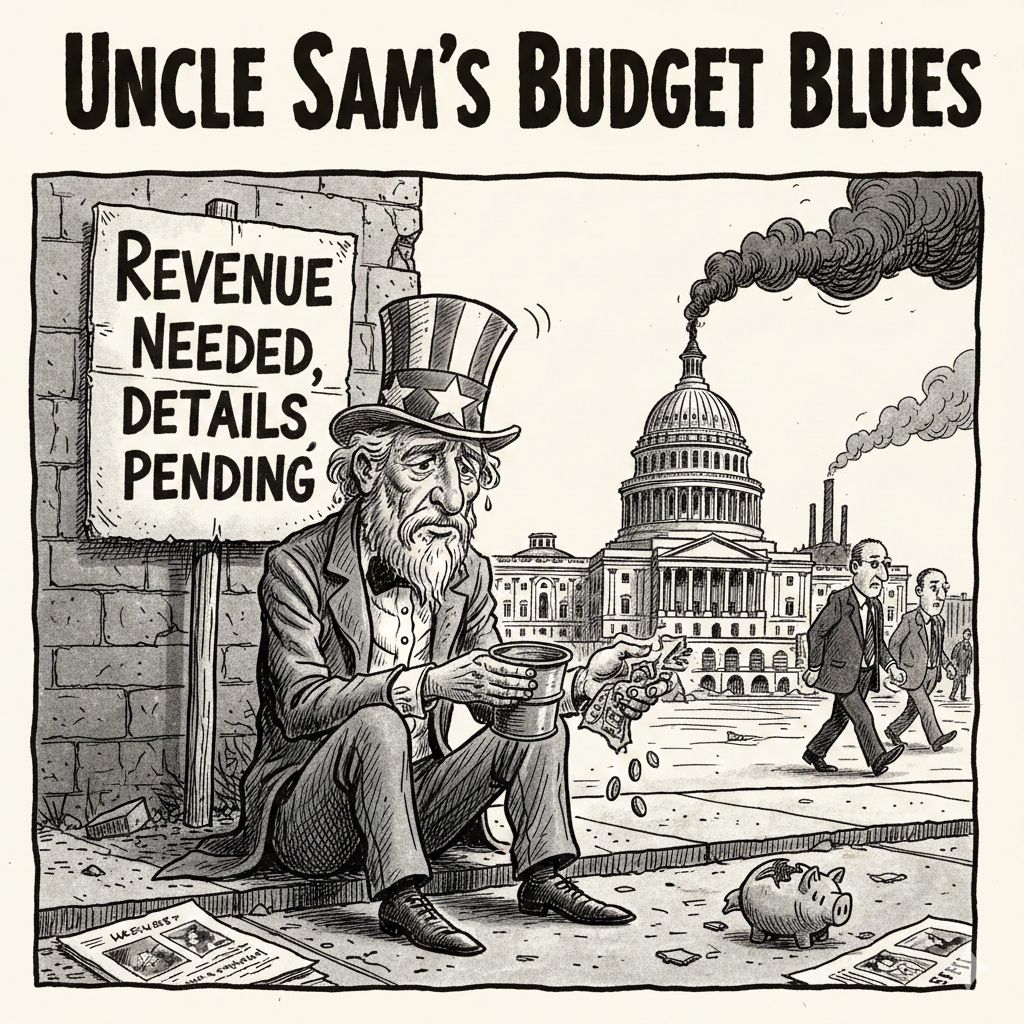
Every few years, American politics rediscovers its favorite genre: the too-good-to-be-true tax plan. This week it comes courtesy of President Donald Trump, who floated the idea that Americans may soon pay little to no federal income tax at all. The reason, he suggests, is tariffs. Lots of them. Enough tariffs, apparently, to replace the single largest source of federal revenue without consequences, complications, or irony.
Republicans cheered. Democrats scoffed. And once again, the country was invited to pick a side instead of asking the obvious follow-up questions.
Trump’s pitch is simple and intentionally seductive. Tariffs on foreign goods, particularly from China and other trade rivals, would generate so much revenue that income taxes could be dramatically reduced or eliminated. It is the political equivalent of finding a coupon that promises free groceries forever if you just stop paying at checkout.
The problem is not that tariffs generate revenue. They do. The problem is scale, math, and reality.
According to Treasury Department data, individual income taxes account for roughly half of all federal revenue. In recent years, that number has hovered around two trillion dollars annually. Tariff revenue, even during the height of Trump’s earlier trade war with China, peaked at roughly eighty billion dollars a year. To replace income taxes entirely, tariffs would need to increase by a factor of twenty five, assuming consumption does not change, prices do not rise, and retaliation does not occur. None of those assumptions hold in the real world.
Republicans tend to gloss over this part, preferring to frame tariffs as a patriotic toll paid by foreign countries. That framing has always been misleading. Tariffs are paid by importers, who pass the cost to consumers. This is not a controversial claim. It is basic economics and has been confirmed repeatedly by the Congressional Budget Office, independent economists, and even internal administration analyses during Trump’s first term.
In other words, replacing income taxes with tariffs does not eliminate the tax burden. It relocates it. Quietly. Regressively. And often without voters realizing what happened until prices rise.
Democrats, meanwhile, have responded by treating the proposal as self-evidently absurd and therefore not worth serious engagement. They point out, correctly, that tariffs function as consumption taxes and disproportionately hit lower and middle income households. They warn of inflation, trade retaliation, and supply chain disruptions. All of that is accurate.
What they rarely acknowledge is their own contribution to the problem. Democrats have spent years defending a tax code so complex and opaque that most Americans cannot explain how much they actually pay or why. They defend payroll taxes that hit workers immediately, deductions that favor the wealthy, and a system where corporate profits often escape taxation entirely while individual wage earners shoulder the load.
When voters hear “no income tax,” they are not responding to Trump’s economic white paper. They are responding to frustration with a system that feels rigged, confusing, and punitive. Democrats keep insisting the system works while simultaneously campaigning on fixing it. That contradiction does not inspire confidence.
Republicans sell the fantasy of painless taxation through tariffs. Democrats sell the fantasy that incremental tweaks will somehow restore trust. Both avoid the uncomfortable truth that the federal government costs money, and someone always pays.
Tariffs also come with geopolitical consequences that neither party seems eager to dwell on. Large scale tariff expansion would almost certainly provoke retaliation from trading partners, disrupt export markets, and place additional strain on global supply chains that are already fragile. The same voters promised tax relief would likely face higher prices on everything from electronics to clothing to household goods.
None of this is theoretical. We have already seen it play out.
During Trump’s first term, tariffs raised prices for American consumers while offering limited long term protection for domestic industries. Farmers required federal bailouts to offset retaliatory tariffs. Manufacturing gains were modest and often temporary. The revenue generated was real, but nowhere near transformative.
And yet, here we are again, debating the idea as if it is brand new.
The two party system excels at this kind of selective memory. Republicans recycle bold promises without reckoning with outcomes. Democrats recycle warnings without offering alternatives that feel tangible to people living paycheck to paycheck. The result is a conversation that feels less like policy debate and more like competing infomercials.
If the goal is tax reform, then say that. Talk honestly about simplifying the code, closing loopholes, reassessing payroll taxes, and balancing revenue with responsibility. If the goal is political theater, then keep promising a future where someone else always foots the bill.
Americans are not confused because they are ignorant. They are confused because both parties keep selling partial truths wrapped in slogans. One promises freedom from taxes. The other promises protection from bad ideas. Neither offers a plan that treats voters like adults.
There is no version of government where roads, defense, healthcare programs, and social safety nets cost nothing. There is only a choice about how transparently those costs are shared.
Until both parties stop pretending otherwise, we will keep cycling through the same promises, the same outrage, and the same disappointment, just with different branding.
And somehow, the bill will still arrive.

 The Political Middle Child
Leave a comment