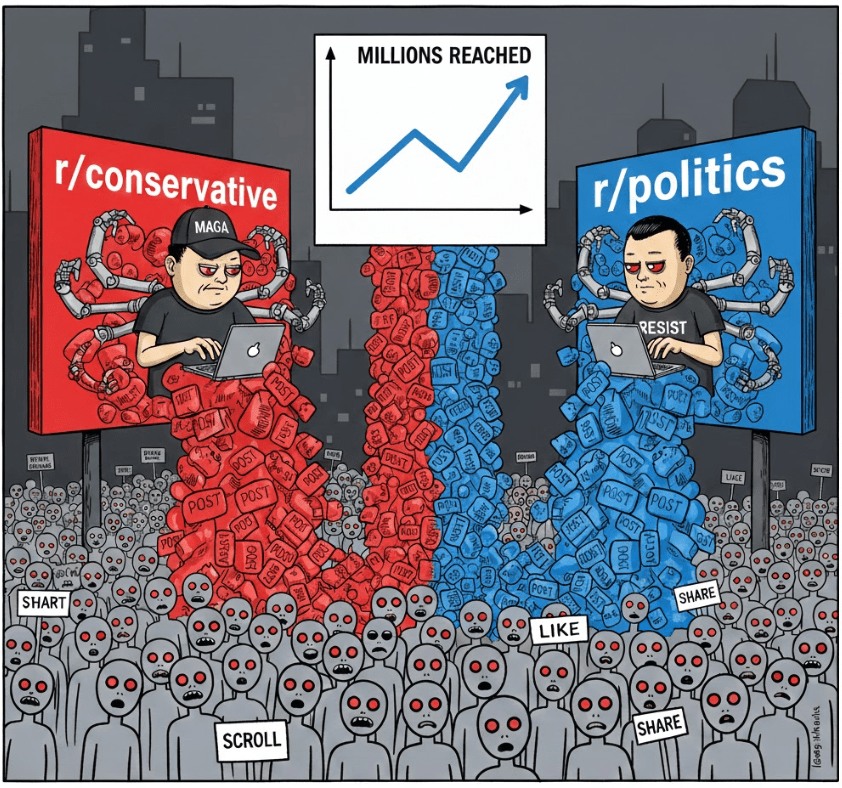
Reddit likes to think of itself as the last major platform driven by users rather than algorithms. No billionaire timelines. No opaque recommendation engines. Just upvotes, downvotes, and the collective will of the crowd.
That story gets harder to believe the closer you look at r/politics and r/Conservative.
On the surface, these communities could not be more different. One skews overwhelmingly liberal, the other aggressively conservative. They argue constantly, accuse each other of bad faith, and treat the opposing subreddit as proof that the other side is brainwashed or artificial.
What they almost never acknowledge is how similar their internal mechanics have become.
Over the past several years, a striking pattern has emerged across both subreddits: an extremely small number of accounts are responsible for a disproportionately large share of posts. Not comments. Posts. The front door to what everyone else discusses.
This is not a casual imbalance. It is structural.
On r/Conservative, analyses have shown that at times just two accounts were responsible for roughly 30 to 50 percent of all daily submissions. These users post relentlessly, often in rapid bursts, frequently at all hours, usually dropping links with minimal or no commentary. They rarely engage in discussion after posting. Their function is not conversation. It is distribution.
On r/politics, the concentration is less extreme but still pronounced. A small cluster of high-karma accounts consistently submits a large share of breaking news links day after day, year after year. Some are confirmed bots, such as the official moderator automation accounts. Others behave like newswire terminals operated by humans, scripts, or teams, posting with remarkable speed, consistency, and emotional detachment. Top Frequent Posters on r_polit…
This is where the conversation usually derails.
Pointing out these patterns does not mean every high-frequency account is a foreign bot. It does not mean Reddit is secretly controlled by shadow governments. And it does not mean the content being shared is false. In many cases, the links are real journalism from mainstream outlets.
The issue is not misinformation. It is information flow.
When a handful of accounts consistently control what gets posted first, they shape what gets seen, discussed, and amplified. Reddit’s design strongly favors the earliest submission of a popular story. Once a link is posted and gains traction, later submissions are removed as duplicates. The first account through the gate sets the frame.
That power matters regardless of ideology.
On r/Conservative, this dynamic creates the appearance of grassroots outrage while often functioning more like a content conveyor belt. Newer, auto-generated usernames with little personal history flood the subreddit with culture war headlines, rarely pausing to interact. Community members themselves have noted that blocking a small group of these prolific posters dramatically reduces the volume of new content, sometimes making the subreddit feel almost empty.
On r/politics, the effect is subtler but no less real. Highly established accounts with massive karma totals post mainstream political news around the clock. They do not editorialize. They do not argue. They do not build relationships. They post, disappear, and return with the next headline. To the casual reader, this feels neutral and organic. In practice, it is still centralized.
The difference is tone, not structure.
Both subreddits rely on a narrow pipeline of posters to feed millions of readers. Both reward speed over reflection. Both create an illusion of mass participation that begins with very few hands on the wheel.
This is not accidental.
Reddit’s incentive system rewards those who post frequently, post early, and post content that aligns with the dominant sentiment of the subreddit. Over time, this naturally filters out casual users and elevates power posters. Whether those posters are individuals, teams, or semi-automated setups becomes almost irrelevant. The outcome is the same.
What is especially telling is how both communities react when this is pointed out.
On the right, accusations of bots are used to delegitimize opposing views. On the left, similar patterns are dismissed as harmless enthusiasm or civic engagement. Each side sees manipulation only when it favors the other.
Neither wants to admit that the architecture itself encourages consolidation.
Reddit is not unique in this. Every major platform eventually centralizes influence. The difference is that Reddit still markets itself as a bottom-up forum. The mechanics say otherwise.
None of this means discussions on these subreddits are fake. The comments are largely real. The arguments are real. The emotions are real. But the menu of topics, the timing of outrage, and the framing of debates are increasingly set by a small number of repeat actors.
That should concern anyone who values open discourse, regardless of political alignment.
The real question is not whether a specific account is a bot. The real question is why a system that claims to represent millions of voices routinely funnels attention through dozens, or sometimes fewer.
If democracy depends on informed participation, then platforms that quietly narrow what gets seen deserve scrutiny. Not because they are partisan, but because they are powerful.
Reddit does not need a conspiracy to distort political conversation. It already has incentives that do the work on their own.
And as long as each side is more interested in proving the other is artificial than examining how the system rewards repetition over deliberation, nothing will change.
The illusion will hold. The front page will refresh. And a few familiar usernames will keep deciding what everyone else argues about next.
 The Political Middle Child
Leave a comment